
A jewelry store showcase layout should give customers room to browse, help employees present merchandise comfortably, and provide a practical place to complete each sale. Planning those details before ordering jewelry display cases helps you choose the right dimensions, access options, lighting, and configuration for your store.
Whether you are opening a new location or updating an existing space, begin with a measured floor plan and a clear picture of how your team works. Tecno Display has manufactured glass showcases in the USA since 1978. Our standard models provide a starting point, with modifications and custom options available for suitable projects.
Plan the merchandise before choosing the cases
Start by deciding which collections belong together and how customers will compare them. Engagement rings, wedding bands, watches, everyday jewelry, and special gifts may each need a different presentation. Within those groups, organize pieces so customers can understand the selection without feeling crowded by too many competing displays.
Measure the presentation materials as well as the jewelry. Ring trays, necklace busts, watch stands, risers, and signage all occupy usable space. Confirm the interior display dimensions and available height of each proposed case; the overall cabinet dimensions do not tell you how much room is available for merchandise.
Use that merchandise map to estimate how many showcases you need and where each collection will sit.
Walk through the customer layout
Look at the store from the entrance. Identify the first display customers will see, the route toward your main collections, and the places where shoppers are likely to stop for a closer look.
Mark proposed fixture footprints on the floor with removable tape. Include chairs, checkout counters, columns, and existing fixtures. Then walk the layout as if customers were browsing while another person received assistance.
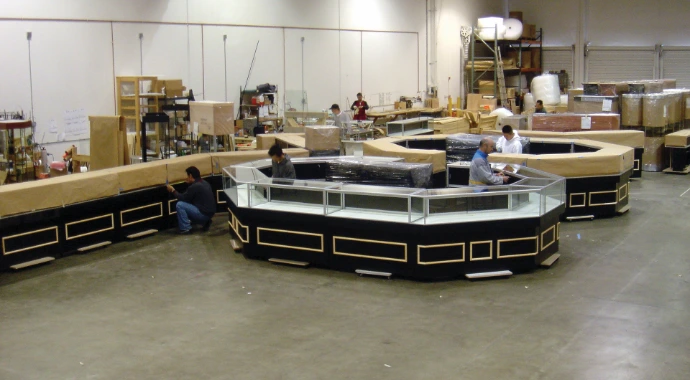
For a jewelry display island, consider the space around every side and the employee entrance. For seated consultations, allow for chairs in use. Review circulation and accessibility requirements with your project designer before finalizing fixture locations.
Check access from the employee side
A showcase should support the full sales presentation. Confirm which side opens, how far employees must reach, and where a tray can be placed while customers compare pieces.
Sliding doors, hinged doors, drawers, and pull-out decks require different working clearances. Confirm which features are available on the selected model and allow room for them to operate. Check whether an employee can open a case while a coworker passes behind it.
Plan storage for frequently used supplies and access for restocking and cleaning. Discuss available lock options alongside your store’s merchandise-handling procedures.
Coordinate lighting with the display
Review case lighting together with the room’s overhead lighting, windows, and intended viewing positions. Reflections and shadows can affect how clearly customers see the jewelry.
Consider the placement of taller busts and risers when discussing lighting. Confirm what lighting is included in the proposed configuration, which options are available, and how power will reach each fixture. Planning outlet locations and cable routing early helps keep cords out of customer and employee pathways.
Plan the checkout around your daily work
List what happens at checkout: reviewing the purchase, taking payment, packaging jewelry, providing documents, and handling repair intake or pickup. Identify the counter space, equipment, and storage each activity requires.
Measure your payment terminal, computer, printer, and packaging supplies. Decide where bags, boxes, forms, and frequently used tools will be kept. Confirm power, data connections, and wiring access before approving the counter configuration.
Tecno Display’s cash wraps and checkout counters can be discussed as part of the overall fixture package. Share your equipment dimensions and workflow so the proposed counter can be reviewed against your actual needs.
Review the fixtures as a complete package
Review straight showcases, corners, islands, and checkout counters together. Confirm how their dimensions, counter heights, display areas, cabinet finishes, and framing will relate across the store.
When fixtures are intended to match, order them together when possible. Natural wood varies in grain and color, and existing finishes can change over time. An exact match between a new fixture and an older installation should not be assumed.
For a remodel, provide current photographs and known finish information. Identify which fixtures will remain and whether you expect to expand later.
Start with a proven showcase model
Compare your layout with Tecno Display’s jewelry display cases, including established models such as the JL100 jewelry showcase. Review the standard dimensions and configuration first, then identify any changes your merchandise or space requires.
A modified-standard case may meet the project’s needs. If the layout requires a fully custom solution, discuss feasibility, pricing, and timing before committing to the design.
Because Tecno Display cases ship assembled, review the delivery route as well as the final floor position. Doorways, elevators, corridors, and tight turns can affect which fixture dimensions will work at your location.
What to prepare before requesting a quote
Gather the following information so the proposed showcases can be evaluated as a coordinated package:
A dimensioned floor plan showing doors, columns, and existing fixtures.
Store photographs and the fixtures you plan to retain.
Merchandise categories and dimensions of trays, busts, and other display materials.
Preferred case models, quantities, finishes, and lighting.
Employee access, storage, seating, and checkout requirements.
Delivery location, access constraints, target timing, and project budget.
Tecno Display can help you compare standard models and discuss appropriate modifications for your project. Share your floor plan and requirements to begin selecting showcases that fit your space and daily operations.
Explore Jewelry Display Cases or Request a Quote.
Phone: (800) 255-3536 | Email: tecno@tecnodisplay.com