
Choosing a museum display case involves more than deciding on dimensions, glass, lighting, and access. Museums also need to consider how the case will arrive and what will be required to get it ready for an exhibit.
For some projects, receiving a display case fully assembled can make the installation process considerably more straightforward. Instead of constructing the main case inside the museum, the receiving team can focus on getting the case into position and preparing it for the objects that will be displayed.
That does not mean a fully assembled display case eliminates the need for installation planning. In fact, because the completed case must travel from the delivery point to its final location, planning the receiving route becomes especially important.
When Limited On-Site Assembly Is Preferred
Museums often work within installation schedules that involve exhibit designers, collections staff, preparators, contractors, and other teams. Adding significant display case assembly to that schedule can create another task that must be coordinated.
A fully assembled case reduces the amount of construction that needs to take place in the gallery or exhibit space.
This may be especially valuable when:
Museum staff have limited time available for installation.
The exhibit has a short installation window.
On-site construction space is limited.
Multiple cases need to be positioned and prepared.
Staff would rather concentrate on mounts, labels, objects, and exhibit setup than case construction.
The objective is not necessarily to eliminate every setup step, but to simplify what must happen after the display case reaches the museum.
When the Case Has Multiple Integrated Features
Museum cases can include more than a glass enclosure. Depending on the model and project, a case may incorporate shelving, access systems, locks, lighting, cabinetry, levelers, or other components.
Receiving the main structure already assembled allows these elements to arrive as part of a completed showcase rather than requiring the museum team to construct the primary case from separate components.
There may still be final setup after delivery. Depending on the case, this could include positioning shelves, preparing removable components, leveling the showcase, or connecting lighting.
Ask about these steps before ordering so your installation team knows exactly what will be required.
When a Consistent Finished Appearance Matters
Museum exhibits frequently rely on clean sightlines and carefully planned presentation. The display case becomes part of the exhibit design rather than simply a container around the objects.
Receiving the main case already constructed means the museum is not relying on a temporary installation area to complete its primary assembly.
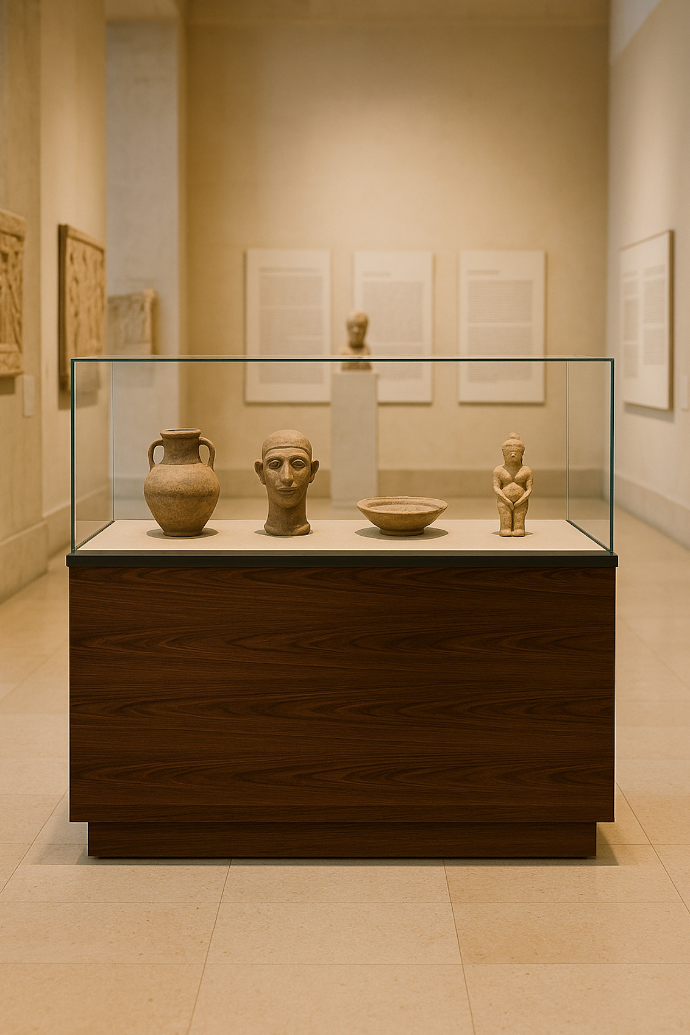
This can be particularly useful for prominent freestanding cases, large showcases, and other displays where visitors will see the case from several angles.
When You Are Planning a Large or Custom Display
The value of assembled delivery can become even more noticeable as a display becomes larger or more specialized.
A museum planning a case for a large artifact, mannequin, collection grouping, or custom exhibit may already need to coordinate dimensions, object placement, staff access, lighting, security, and mounting requirements.
Reducing the amount of case construction that must happen at the museum removes one additional installation variable.
However, larger assembled cases also make receiving access more important.
Fully Assembled Does Not Mean Delivery Planning Can Be Skipped
Before choosing an assembled display case, confirm that the completed case can physically reach its intended location.
Start at the delivery point and follow the entire route the case will take through the building.
Consider:
Doors and entrances: Will the case and its shipping configuration fit through each opening?
Hallways and corners: Is there enough room to maneuver the case?
Elevators: If the exhibit is on another floor, confirm elevator door openings and interior dimensions.
Loading and receiving areas: Determine how the shipment will be unloaded and moved into the building.
Final placement: Make sure the case can be positioned where planned without obstacles from walls, permanent exhibits, fixtures, or other cases.
Do not compare only the exhibit space with the finished display-case dimensions. Shipping and receiving requirements should be discussed before the order is finalized.
What to Confirm Before Ordering
A museum considering a fully assembled display case should provide as much project information as possible before selecting a model.
Useful details include the size of the objects and mounts, desired viewing angles, staff access requirements, shelving needs, lighting, security requirements, exhibit location, and receiving route.
Providing this information early makes it easier to determine whether a standard display case will work or whether a custom configuration would better fit the exhibit.
Plan the Display and the Delivery Together
A fully assembled museum display case can be a practical choice when reducing on-site construction, simplifying exhibit installation, and receiving a completed showcase are priorities.
The best results still come from planning beyond the case itself.
Before ordering, think about the objects going inside the case, how staff will access them, how visitors will view them, and how the completed showcase will travel from the delivery point to its final position.
Tecno Display manufactures standard and custom display cases for museums, universities, institutions, and other commercial environments. If you are beginning a museum display project, contact Tecno Display to discuss the case dimensions, exhibit requirements, access needs, and delivery considerations before selecting your display solution.
Request a quote to discuss assembled display cases. Call (800) 255-3536 or email tecno@tecnodisplay.com.